Nocturnal marine animals need darkness, quiet, and room to move; observing them from a safe distance is one of the simplest ways to reduce disturbance. A safe distance is not one universal number: it depends on the species, its behavior, local regulations, and the conditions of the encounter. Scientific research shows that artificial light can alter marine animals’ behavior, while wildlife agencies and conservation organizations advise observers to avoid approaching, touching, feeding, or blocking animals. This guide explains how distance, lighting, noise, and encounter-specific choices can help protect nocturnal marine life—and how to respond when an animal comes close on its own.
Reducing disturbance through safe distance from nocturnal marine life
“Safe distance” means enough separation to observe an animal without prompting it to change its normal behavior or compromising its ability to feed, rest, travel, surface, or retreat. There is no scientifically established distance that suits every nocturnal species or situation. Instead, the practical standard is to keep well back, follow local rules and site guidance, and increase distance if an animal reacts or conditions make an encounter difficult to control.
The concern is not merely theoretical. In a 2018 review in Nature Ecology & Evolution, researchers described artificial light at night as a widespread pollutant with potential effects on species, ecological interactions, and ecosystem processes. Light can attract some marine animals, disorient others, or alter movement and habitat use. Noise and close approaches can also disturb wildlife, even when an observer sees no obvious reaction. The safest approach combines distance with dim, shielded lighting, low noise, and respect for the animal’s route.
Safe distance defines responsible nocturnal wildlife observation
The National Oceanic and Atmospheric Administration (NOAA) describes responsible wildlife viewing as keeping a respectful distance and avoiding actions that disturb or alter an animal’s natural behavior. For nocturnal marine encounters, that principle means observing without pursuing, surrounding, touching, feeding, shining bright light directly at an animal, or positioning yourself between it and open water or shelter.
The relevant distance varies with animal size, mobility, sensitivity, habitat, and the observer’s equipment. A small fish under a ledge, a resting seal on shore, and a whale surfacing near a vessel require different responses. Follow posted rules and local wildlife guidance first; where no numerical minimum is specified, use a conservative buffer and back away at the first sign of disturbance. Potential signs include fleeing, repeatedly changing direction, abandoning a resting place, interrupting feeding, or showing agitation.
Approach distance and animal response
Approach distance is the space between an observer and an animal, while response distance is the point at which the animal begins to react. The latter can differ among individuals and encounters. Because a reaction may be subtle or difficult to see in darkness, observers should not test how close they can get. Start far away, move slowly only when permitted, and stop approaching if the animal changes its behavior.
The U.S. Fish and Wildlife Service emphasizes keeping a respectful distance from wildlife and using binoculars or a camera zoom rather than moving closer. At sea, a vessel should not chase or cut off an animal’s path. For marine mammals, federal protections and local regulations may prescribe specific approach limits; those rules can vary by species and activity, so check current requirements before entering the water or operating a boat.
Light, noise, and movement as disturbance pathways
Distance alone cannot prevent disturbance if observers use powerful lights, loud equipment, or sudden movement. Artificial light can change orientation and behavior, particularly for animals that navigate or forage in darkness. A 2020 review in Frontiers in Ecology and the Environment assessed the ecological effects of artificial light at night and highlighted the need to manage lighting as a form of environmental pollution.
Use the minimum light needed for safety, aim it away from wildlife, and favor shielded, low-intensity illumination where permitted. Do not assume that red light is harmless: responses differ among species, and no color guarantees that an animal will not be disturbed. Keep voices low, avoid splashing or sudden fin movements, and do not use flash photography around wildlife unless local authorities explicitly permit it.
Nocturnal species require encounter-specific observation practices
“Nocturnal marine life” includes animals active mainly at night as well as normally daytime species that rest or shelter after dark. Examples include reef fish and invertebrates encountered during night dives, sea turtles nesting on beaches, seals hauled out to rest, and marine mammals that surface or travel in darkness. Their needs differ, so safe viewing begins by identifying the animal and the relevant local rules rather than applying one distance to all.
Night diving and reef animals
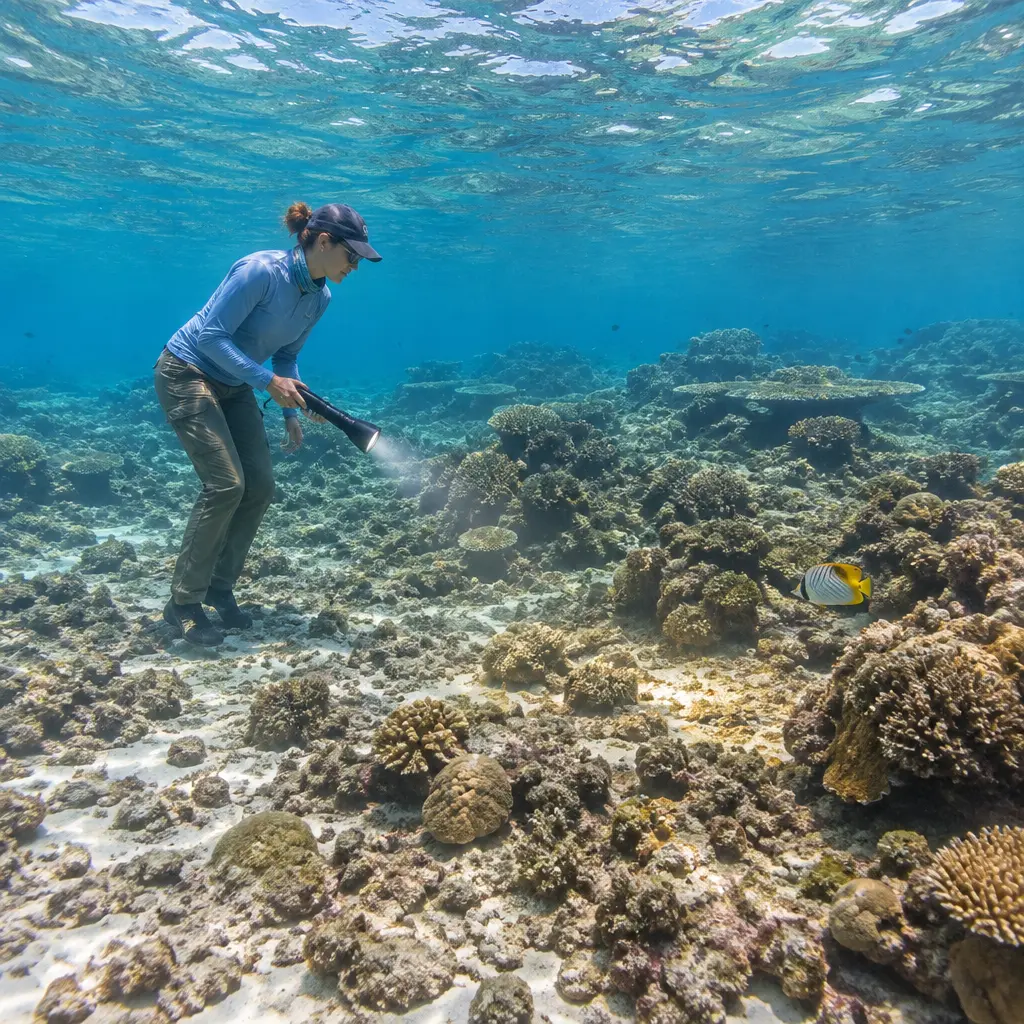
During a night dive, keep buoyancy controlled and avoid contact with coral, rocks, and animals. Coral reefs are living structures: NOAA notes that corals can be damaged by physical contact, and careless finning can break or stir up fragile habitat. Observe from a stable position rather than chasing an animal, and do not place a light directly into crevices where animals are resting or sheltering.
A dive light should illuminate the route and the immediate viewing area, not flood the reef. A buddy’s light can be aimed away from the animal to reduce combined exposure. Do not collect, handle, or feed animals, and avoid blocking exits from crevices. If a creature retreats, stops feeding, or repeatedly turns away, increase distance and end the observation.
Sea turtles and nesting beaches
Nesting sea turtles and hatchlings are especially vulnerable to human presence and artificial lighting. The U.S. Fish and Wildlife Service explains that artificial beachfront lights can disorient hatchlings, drawing them away from the ocean. On nesting beaches, keep well away, remain quiet, avoid flash photography, and follow instructions from trained monitors. Never touch a turtle, hatchling, nest, or marked nesting area.
Beach lighting can also affect nesting females. Communities and visitors can reduce impacts by turning off unnecessary lights, closing curtains facing the shore, and using properly shielded fixtures that direct light downward where local guidance allows. If a turtle appears, do not surround it or stand between it and the sea; give it a clear path and notify local wildlife authorities or a permitted conservation monitor if assistance is needed.
Seals, whales, and other marine mammals
Marine mammals may be resting, nursing, feeding, or traveling when encountered at night. A seal on shore should not be approached, touched, or coaxed back into the water; resting ashore can be normal behavior. NOAA advises people to give marine mammals space and to avoid actions that disrupt their natural behavior. If an animal approaches, remain calm, stop moving toward it, and allow it to pass without blocking its route.
Boat operators should reduce speed where wildlife may be present, keep a steady course when required by local guidance, and avoid sudden turns or repeated approaches. Federal rules in the United States prohibit harassment of marine mammals under the Marine Mammal Protection Act; other jurisdictions have their own protections and approach requirements. Consult the relevant authority for current species-specific distances rather than relying on an informal rule of thumb.
Low-impact practices make safe-distance guidance actionable
The distance principle works best as part of a broader plan: learn the rules, prepare equipment, observe quietly, and leave if conditions or animal behavior change. These practices help protect wildlife while improving safety for divers, boaters, photographers, and shoreline visitors.
- Check protected-area rules, seasonal closures, and species-specific guidance before an outing.
- Use binoculars, a zoom lens, or a camera’s low-light capability instead of moving closer.
- Keep lights dim, shielded, and directed away from animals; avoid flash unless expressly allowed.
- Move slowly and quietly, and never chase, surround, touch, feed, or block an animal.
- Back away if the animal changes its behavior, appears distressed, or cannot move freely.
- Report injured or entangled wildlife to the appropriate local rescue or wildlife authority without attempting a risky intervention.
A simple field illustration can help explain the decision: imagine three concentric zones around an animal—an outer observation area, a buffer that observers should not cross, and the animal’s immediate escape or resting space. The boundaries are not fixed measurements; local regulations and observed behavior determine them. The key is that observers should not enter the animal’s space simply to obtain a closer view.
Conclusion: distance protects nocturnal marine life and people
Safe distance is a behavior-based practice, not a single number. Responsible observation pairs adequate separation with reduced light and noise, unobstructed escape routes, and compliance with local wildlife rules. Night divers should protect reef habitat; beach visitors should safeguard nesting turtles and hatchlings; and boaters and shore observers should allow marine mammals to rest and travel undisturbed.
Before your next nighttime encounter, check official guidance, use observation tools rather than approaching, and leave more space whenever an animal reacts or the situation is uncertain. These choices reduce avoidable stress and support the broader conservation goal of keeping marine habitats dark, quiet, and functional.
Sources: NOAA Fisheries, Viewing Marine Life, https://www.fisheries.noaa.gov/topic/marine-life-viewing-guidelines; NOAA Fisheries, Marine Mammal Protection Act, https://www.fisheries.noaa.gov/national/marine-mammal-protection/marine-mammal-protection-act; U.S. Fish and Wildlife Service, Sea Turtles and Artificial Lighting, https://www.fws.gov/story/2023-06/sea-turtles-and-artificial-lighting; U.S. Fish and Wildlife Service, Wildlife Watching, https://www.fws.gov/program/national-wildlife-refuge-system/visitor-activities/wildlife-watching; Gaston, K. J., Visser, M. E., and Hölker, F., The Biological Impacts of Artificial Light at Night: The Research Challenge, Philosophical Transactions of the Royal Society B, 2015, https://doi.org/10.1098/rstb.2014.0133; Davies, T. W. and Smyth, T., Why Artificial Light at Night Should Be a Focus for Global Change Research in the 21st Century, Global Change Biology, 2018, https://doi.org/10.1111/gcb.13927; Sanders, D. et al., A Meta-Analysis of Biological Impacts of Artificial Light at Night, Nature Ecology & Evolution, 2021, https://doi.org/10.1038/s41559-020-01322-x.