Underwater strobe lighting is the use of brief, controlled flashes to illuminate a subject below the surface. Because water absorbs and scatters light unevenly—removing red wavelengths faster than blue—strobes can restore red-rich color to nearby subjects by supplying white light at close range. The result depends on depth, water clarity, subject distance, strobe placement, and exposure: a flash cannot bring back color that has been lost from distant water in the same way it can illuminate a nearby fish or coral. Understanding this distinction helps photographers choose strobe power and positioning, balance flash with ambient light, and avoid backscatter while producing more natural-looking images.
How Water Absorption Shapes Underwater Strobe Lighting
Water does not transmit all colors equally. NOAA explains that light is absorbed and scattered as it travels through water, with longer wavelengths such as red generally disappearing before shorter blue wavelengths. The exact rate varies with water clarity, dissolved materials, and suspended particles, so there is no single depth at which every underwater scene turns blue. The practical photographic rule is that color loss increases with the distance light travels through water, including the path from the surface to the subject and from the subject to the camera.
A strobe addresses this problem locally: its broad-spectrum flash illuminates a nearby subject, returning red and other wavelengths to the light reflected into the camera. It does not reverse the water’s absorption or restore red to the entire background. This is why close subjects can appear vivid while distant water remains blue or green. Hyponyms, or specific approaches within underwater flash lighting, include single-strobe lighting, dual-strobe lighting, macro lighting, and wide-angle ambient-light-and-strobe balancing.
Red-Light Loss and Subject Distance
Red-light loss is the reduction of red wavelengths as light travels through water. For photography, the key variable is not depth alone but the total water path. A subject photographed close to the lens requires the strobe’s light to travel a shorter distance through water than a subject photographed several metres away. Consequently, moving closer often improves color and contrast more reliably than simply increasing flash power.
This distinction also explains why a strobe cannot make a faraway reef look as though it were in air. Light reflected from a distant subject still passes through water on its way back to the camera, and haze or particles can reduce contrast. The Smithsonian Ocean and NOAA describe how water clarity and suspended particles affect underwater visibility; photographers should treat distance and water conditions as part of exposure planning, not just camera settings.
Color Temperature and White Balance
Color temperature describes the color appearance of a light source, while white balance adjusts how a camera renders neutral tones under that source. A strobe supplies a brief, relatively daylight-like spectrum, helping a camera record subject colors that ambient underwater light no longer carries well. White balance can refine the result, but it cannot recreate wavelengths that never reached the subject or sensor. For reliable color, photographers generally expose the subject with flash and use white balance to manage the remaining ambient-light contribution.
How Strobe Placement Restores Subject Color
Strobe placement determines how much light reaches the subject and how much suspended material reflects flash back toward the lens. Underwater photography guidance from equipment manufacturers such as Ikelite and Backscatter commonly emphasizes positioning strobes outward from the camera housing and aiming them across the subject rather than directly along the lens axis. This geometry reduces the chance that particles between camera and subject will be brightly illuminated in the image.
Single-Strobe Lighting
A single strobe is a compact setup in which one flash illuminates the subject from one side. It can work well for macro subjects and close portraits, where the photographer can place the light carefully and keep the water path short. Angling the strobe slightly toward the subject, rather than pointing it straight ahead, helps light the subject while limiting direct illumination of particles near the lens.
Dual-Strobe Lighting
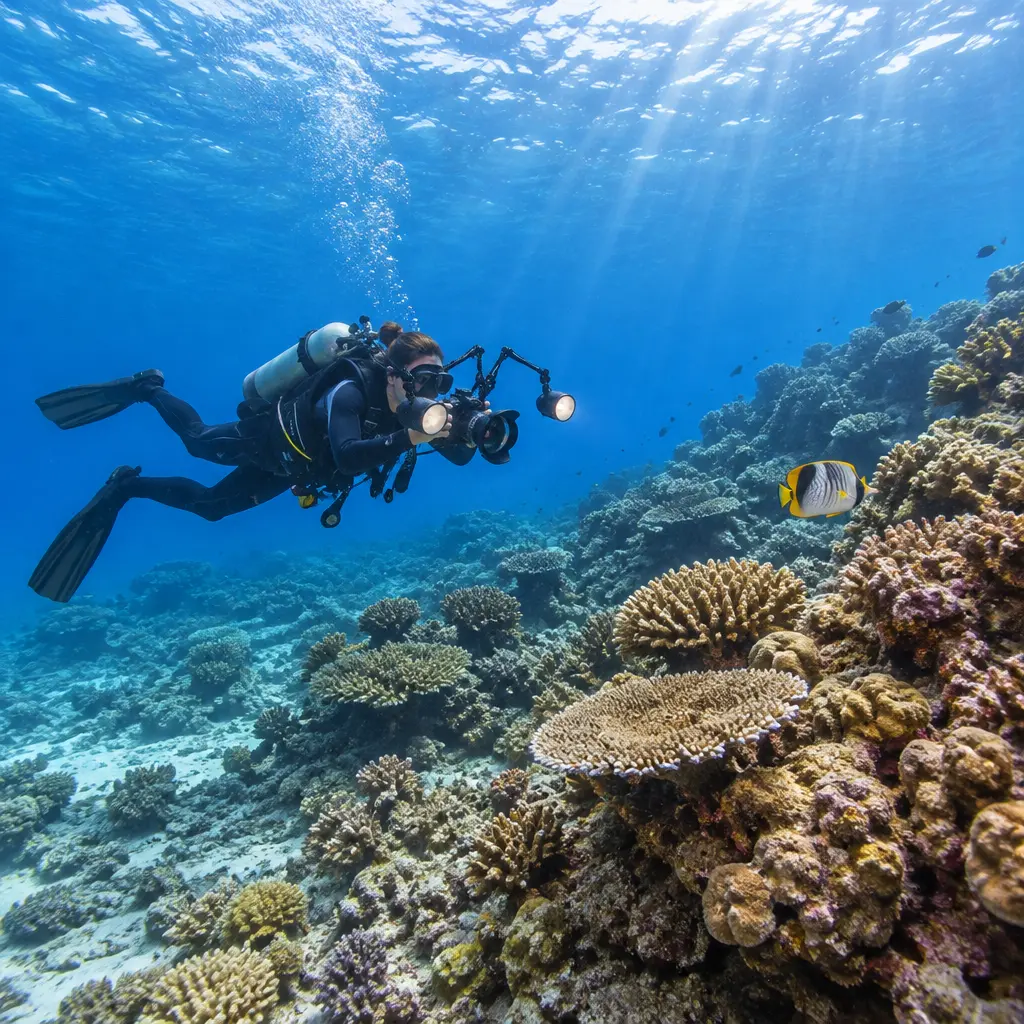
Dual-strobe lighting uses two flashes to provide broader, more even illumination and reduce harsh shadows. For close wide-angle subjects, photographers often begin with the strobes spaced apart and angled outward, then adjust their aim according to subject size and distance. The goal is not maximum brightness everywhere: overly frontal or excessively powerful flash can flatten texture, create hotspots, and illuminate backscatter.
Macro and Wide-Angle Applications
Macro photography benefits from strobes because small subjects can be illuminated at close range, where flash color is effective and easy to control. Wide-angle photography presents a greater challenge: the frame may include both a nearby foreground subject and a large area of distant water. In that case, strobes should light only the foreground subject, while ambient light and camera exposure determine the appearance of the water and background.
Balancing Strobe Exposure with Ambient Light
An underwater image often combines two exposures: the strobe-lit subject and the ambient-lit background. Shutter speed primarily affects how much ambient light is recorded, while aperture and ISO influence both ambient exposure and flash exposure; flash power and strobe-to-subject distance also affect the illuminated subject. This is a practical starting model rather than an absolute separation, since camera synchronization, flash duration, and exposure settings influence the final result.
Exposure Controls and Flash Power
When the background is too bright, a photographer can reduce ambient exposure—for example, by using a faster shutter speed within the camera’s flash-sync limit or a smaller aperture. When the subject is too dark, the photographer can increase strobe output, open the aperture, raise ISO, or move the strobe closer. Moving closer is often efficient because flash illumination falls off rapidly with distance; the inverse-square relationship is a useful approximation in clear conditions, although underwater scattering and equipment geometry complicate real scenes.
Backscatter and Water Clarity
Backscatter is the bright reflection of flash from suspended particles between the camera and subject. It becomes more noticeable in silty, plankton-rich, or otherwise particle-filled water. Reducing it involves bringing the strobes away from the lens axis, aiming them inward only as much as needed to cover the subject, and minimizing the water column between camera and subject. In very poor visibility, even careful lighting may not eliminate particle reflections; changing position or waiting for clearer conditions can be more effective than adding power.
Ambient-Light Backgrounds and Blue Water
A blue-water background is often intentional rather than a lighting failure. By exposing the background with available sunlight and using strobes to illuminate the foreground, photographers preserve a sense of depth while restoring subject color. A useful field workflow is to make a test exposure for the background first, then adjust strobe output until the subject is properly lit without losing texture or appearing unnaturally bright.
A Practical Workflow for Restoring Color
- Move close enough to the subject to limit the water path, while maintaining a safe and respectful distance from wildlife and fragile habitat.
- Choose a suitable starting position for the strobe or strobes, keeping them outside the lens axis to reduce backscatter.
- Set exposure for the desired ambient background, staying within the camera’s flash-sync limits.
- Adjust flash power or strobe distance to expose the subject, checking highlights and color on the camera display.
- Fine-tune strobe angle to reveal texture and reduce hotspots, particle reflections, and hard shadows.
- Review the image at the scene: if the subject remains dull, first check distance, aim, and exposure before assuming the strobe needs more power.
For example, a close reef fish photographed in clear tropical water may show stronger reds and warmer tones when lit with a carefully angled strobe, while the open-water background remains blue. The same setup in turbid water may produce particle highlights, requiring wider strobe placement and a shorter camera-to-subject distance. These outcomes illustrate why strobe technique must respond to conditions rather than rely on a fixed depth rule.
Conclusion: Strobes Restore Color Locally, Not Across the Water
Water absorption explains why red wavelengths fade with increasing water path; strobe placement determines how effectively flash restores color to a nearby subject; and ambient-light balancing shapes the surrounding water and background. The most dependable approach is to get close, position strobes to light the subject rather than the particles, and adjust ambient exposure separately from flash power. These principles improve color and contrast while encouraging careful, low-impact photography around marine life. For further practice, compare test frames at different strobe angles and distances, and consult your camera and strobe manufacturers’ manuals for model-specific synchronization and exposure limits.
Sources: NOAA Ocean Service, “Why is the ocean blue?”, https://oceanservice.noaa.gov/facts/oceanblue.html; Smithsonian Ocean, “Ocean Light,” https://ocean.si.edu/ocean-life/oceanic-life/ocean-light; Ikelite, “Underwater Strobe Positioning,” https://www.ikelite.com/blogs/ underwater-photography/underwater-strobe-positioning; Backscatter, “Underwater Strobe Lighting Techniques,” https://www.backscatter.com/reviews/post/Underwater-Strobe-Lighting-Techniques