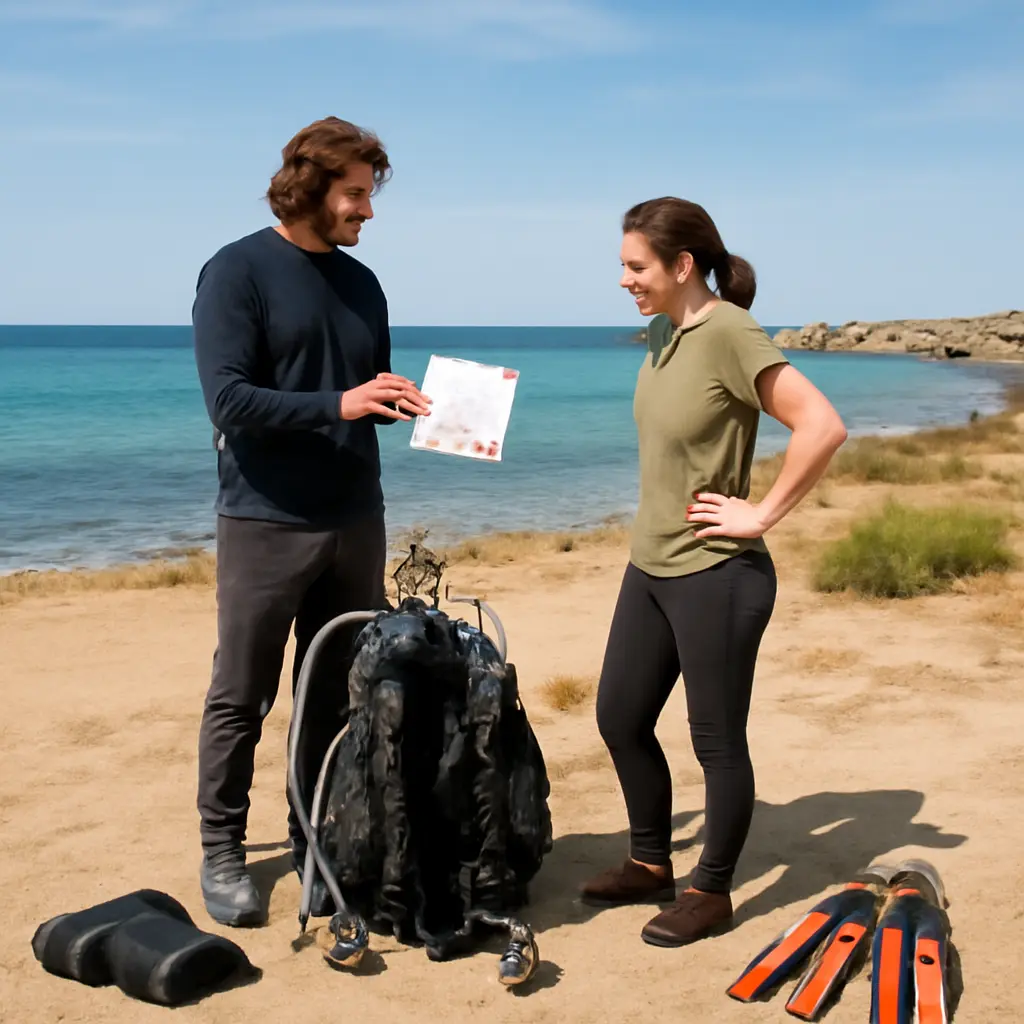
A beginner scuba diving experience is a supervised introduction to breathing underwater with scuba equipment, usually combining a safety briefing, basic skills practice, and a short open-water dive. It is often called a “discover scuba” or introductory dive, and it differs from certification training: participants try diving under close instructor supervision but do not earn an independent-diver certification. The experience typically lasts a few hours, though the time underwater varies by operator, conditions, and participant comfort. Understanding the briefing, equipment, skills, health screening, and supervision helps beginners know what to expect and choose a responsible provider.
What a Beginner Scuba Diving Experience Involves
Scuba diving uses a self-contained underwater breathing apparatus to supply breathing gas while a diver is underwater. A beginner experience is a guided, entry-level activity in which a qualified professional introduces a participant to essential equipment and a small number of basic skills, then supervises them in a pool or open water. The Professional Association of Diving Instructors (PADI) describes its Discover Scuba Diving program as an introductory experience, not a certification course; its format may include confined-water practice and an open-water dive, depending on the program and local conditions.
The main elements are preparation, equipment fitting, skill practice, and a closely supervised dive. The order and depth depend on the operator, training agency, age requirements, environment, and the participant’s comfort. The World Recreational Scuba Training Council (WRSTC) publishes minimum training standards used by participating recreational training organizations, while local laws and site rules may add further requirements. A beginner should therefore check the exact itinerary and supervision arrangements rather than assume every introductory dive is identical.
Health screening and readiness
Health screening is a safety check for conditions that could make diving riskier or require medical advice. Participants generally complete a medical questionnaire and disclose relevant health history honestly. The Divers Alert Network (DAN) advises divers to seek guidance from a physician trained in dive medicine when a screening answer indicates that medical evaluation is needed. A beginner should also tell the instructor about anxiety, recent illness, medications, or difficulty equalizing ear pressure. Do not dive while impaired by alcohol or recreational drugs, and do not treat an introductory booking as proof that a medical condition is safe for diving.
Briefing, equipment, and basic skills
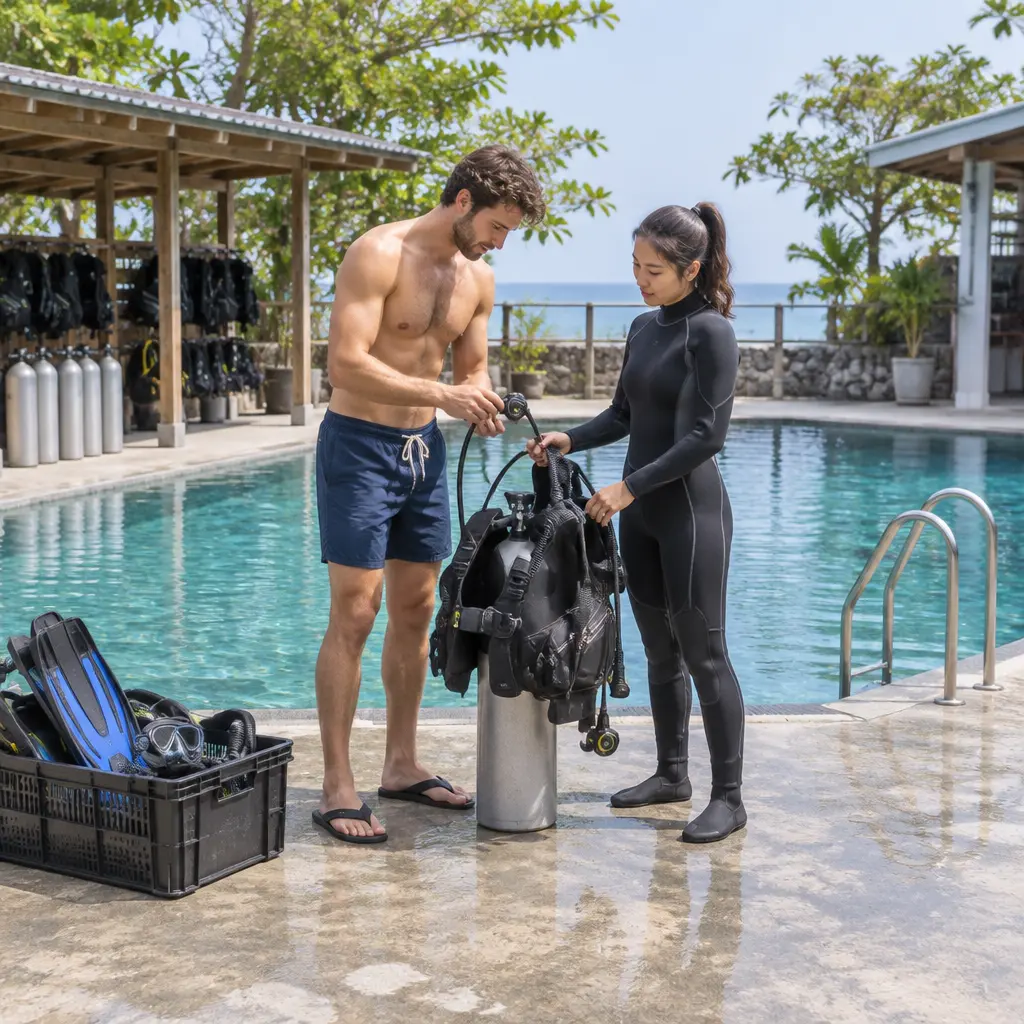
Before entering the water, the instructor explains hand signals, breathing, movement, equalizing pressure in the ears, and what to do if a participant feels uncomfortable. The equipment commonly includes a mask, fins, a buoyancy compensator, a cylinder, a regulator, and exposure protection appropriate to the water temperature. The regulator delivers breathing gas from the cylinder, while the buoyancy compensator helps the diver adjust buoyancy at the surface and underwater.
In a pool or other confined-water setting, a beginner may practice breathing through the regulator, clearing a small amount of water from the mask, and recovering the regulator if it is displaced. The instructor demonstrates each skill and adapts practice to the participant. The purpose is not to master every technique in one session; it is to understand the basic actions and communicate clearly before moving on.
The supervised dive
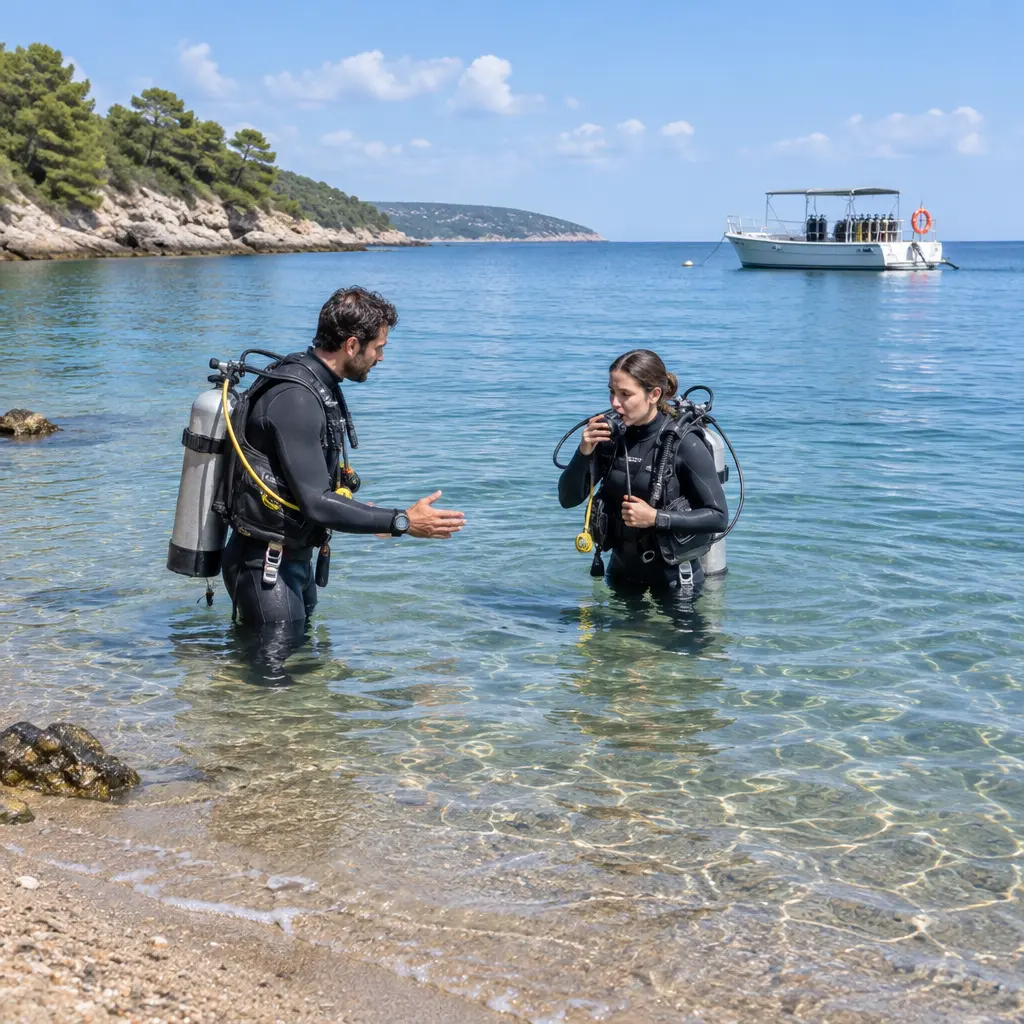
An open-water introductory dive is a short, guided underwater outing in a natural site such as a sheltered bay or reef. The instructor controls the route and depth, monitors the participant, and remains close enough to assist. The actual dive may be shorter than expected because of comfort, air use, visibility, currents, water temperature, or other conditions. Participants should be able to pause or end the activity at any time; a responsible guide will not pressure someone to continue.
The U.S. National Oceanic and Atmospheric Administration (NOAA) explains that increasing water pressure affects a diver’s body and the gas in air spaces, which is why equalizing and following ascent instructions matter. Beginners should follow the instructor’s directions, breathe continuously rather than hold their breath, and ascend at the pace specified by the guide. If anything feels wrong, use the agreed signal and communicate promptly.
How Beginner Scuba Experiences Differ by Setting and Format
Introductory experiences can be grouped by where skills are practiced and whether the activity is part of a longer course. These formats share the same basic goal—safe familiarization under professional supervision—but differ in environment, duration, and what the participant can do afterward.
Pool or confined-water introduction
A confined-water introduction takes place in a swimming pool or similarly controlled water environment. It is useful for trying the equipment and practicing introductory skills without the additional variables of waves, currents, or limited visibility. Some operators offer this as a stand-alone experience; others use it as the first stage before an open-water dive.
Open-water discovery dive
An open-water discovery dive introduces a participant to a natural aquatic environment under direct supervision. Conditions vary substantially between sites: a calm, shallow location is different from a site with surge, current, cold water, or restricted visibility. Ask the operator about the planned site, maximum depth, instructor-to-participant arrangements, equipment, and what happens if weather or water conditions change.
Introductory experience versus certification course
An introductory dive is an experience, not a license to dive independently. Certification courses include structured knowledge development, repeated skills practice, and required training dives, followed by an assessment. For example, PADI’s Open Water Diver course is a certification pathway, whereas its Discover Scuba Diving program is designed to let a person try scuba under professional supervision. Exact requirements vary among agencies, so prospective students should confirm course content and recognition with the training organization.
Safety, Risks, and Choosing a Responsible Operator
Scuba diving is a recreational activity with real risks, including ear or sinus injuries, problems related to pressure changes, and emergencies associated with equipment or environmental conditions. DAN’s annual reports analyze diving incidents and fatalities, but their case data should not be read as a measure of the risk of any single beginner session: circumstances and reporting vary. The practical takeaway is to choose a properly qualified operator, disclose health concerns, listen to the briefing, and stop if you are uncomfortable.
Questions to ask before booking
- Which training agency and instructor qualifications apply to the experience?
- What is the maximum depth, and how long is the expected underwater portion?
- How many participants will each instructor supervise, and how close will the instructor stay?
- What health screening is required, and what should I do if my answers indicate a medical review?
- What equipment, transportation, and safety support are included?
- How does the operator decide whether conditions are suitable, and what is the cancellation policy?
A reputable operator should answer these questions clearly, provide properly maintained equipment, explain how to signal discomfort, and avoid promising that every participant will complete a dive. If a briefing is rushed or a participant’s concerns are dismissed, reconsider taking part.
What to Expect After the Experience
After surfacing, participants usually return equipment, discuss how the dive went, and may receive information about further training. A person who enjoyed the experience can consider a certification course, which builds skills progressively and prepares divers for activities within the limits of their training. An introductory dive alone does not qualify someone to rent equipment or dive without the required supervision.
For travel, follow the instructor’s advice on post-dive altitude exposure. DAN recommends waiting before flying after diving; its guidance distinguishes between a single no-decompression dive and multiple dives or multiple days of diving, with longer waits recommended for the latter. Because schedules, dive profiles, and individual circumstances differ, confirm the appropriate interval with the operator or a dive-medicine professional rather than relying on a generic travel assumption.
Conclusion
A beginner scuba diving experience typically involves health screening, an equipment and safety briefing, basic skill practice, and—when conditions and comfort allow—a short supervised dive. Pool introductions, open-water discovery dives, and certification courses are related but distinct formats. The most important considerations are honest health disclosure, clear instruction, suitable conditions, close supervision, and understanding that an introductory experience does not confer certification. Before booking, ask the operator about the site, depth, group supervision, and safety procedures; if you want to dive independently later, pursue a recognized certification course.
Sources: Professional Association of Diving Instructors (PADI), Discover Scuba Diving, https://www.padi.com/courses/discover-scuba-diving; Professional Association of Diving Instructors (PADI), Open Water Diver, https://www.padi.com/courses/open-water-diver; World Recreational Scuba Training Council, Training Standards, https://wrstc.com/standards/; Divers Alert Network (DAN), Medical Statement and Guidelines for Recreational Scuba Divers, https://dan.org/health-medicine/health-resources/dive-medical-reference-books/medical-guidelines-for-recreational-scuba-divers/; Divers Alert Network (DAN), Annual Diving Report, https://dan.org/safety-prevention/diver-safety/diving-incidents/; Divers Alert Network (DAN), Flying After Diving, https://dan.org/health-medicine/health-resources/dive-medical-reference-books/flying-after-diving/; National Oceanic and Atmospheric Administration (NOAA), Diving, https://oceanservice.noaa.gov/education/tutorial_corals/coral09_hazards.html.