Scuba diving’s first skills are the practical abilities that help a diver breathe underwater, control buoyancy, equalize pressure, communicate, and respond to problems. Entry-level courses teach these skills in a supervised progression: students first practise in confined water, then demonstrate them in open water. The sequence matters because buoyancy and breathing affect nearly every other task, while equipment checks, hand signals, and basic emergency procedures help divers manage risk. The Professional Association of Diving Instructors (PADI) and other training agencies set course standards; the Divers Alert Network (DAN) also emphasizes preparation, conservative decision-making, and continuing education.
Build buoyancy control as a core scuba skill
Buoyancy control is the ability to adjust a diver’s tendency to rise, sink, or remain suspended in the water. It combines breathing, buoyancy-control-device (BCD) use, weighting, body position, and movement. Divers Alert Network describes buoyancy as a central safety and comfort skill: poor control can lead to unintended ascents or descents, contact with the bottom, and extra exertion. That makes it a foundation for navigation, air management, and protecting aquatic environments.
Adjust buoyancy with breathing and the BCD
A diver’s lungs act as a small, continuous buoyancy adjustment. Inhaling generally makes a diver rise slightly; exhaling generally makes the diver descend slightly. The BCD provides larger adjustments, especially at the surface and when compensating for changing depth. In training, students practise adding or releasing small amounts of air, then pausing to assess the result rather than making repeated, large corrections. At depth, compressed air in the BCD expands as the diver ascends, so divers must release expanding gas to avoid an uncontrolled rise.
Choose appropriate weighting and body position
Weighting is the amount and placement of ballast needed to offset the diver’s exposure suit and equipment. Too much weight can require excessive air in the BCD; too little can make it difficult to descend or remain at a planned depth. Instructors teach students to check weighting under controlled conditions, with the equipment and exposure suit they will actually use. A horizontal, streamlined posture also reduces drag and helps prevent fins from striking reefs or stirring sediment. Exact weight needs vary with the diver, gear, water salinity, and suit thickness, so there is no single correct number for every student.
Manage breathing and pressure equalization
Breathing and equalization are the skills that help a diver cope with the underwater environment. Scuba students learn to breathe continuously from the regulator, monitor their remaining gas, and equalize pressure in air spaces as they descend. These actions are closely linked: a calm, controlled descent gives the diver time to equalize, while rushing can increase discomfort and risk. The World Recreational Scuba Training Council’s standards provide a framework for entry-level training, while course agencies teach the practical techniques used to meet them.
Breathe continuously from the regulator
A regulator delivers breathing gas from the cylinder at a pressure suitable for the surrounding water. New divers practise breathing slowly and continuously, without holding their breath during ascent or descent. They also learn to check their pressure gauge and tell a buddy or instructor when their gas supply is getting low. Gas use varies with depth, exertion, experience, equipment, and individual physiology, so students are trained to monitor their own supply rather than rely on a fixed time estimate.
Equalize ears and other air spaces during descent
Equalization is the act of balancing pressure in body air spaces with the surrounding water pressure. Divers commonly equalize their ears gently and early, repeating as needed while descending. They should descend slowly and stop if they feel pain or cannot equalize; forcing the descent can cause an injury. The Divers Alert Network advises divers to avoid diving with congestion that prevents equalization and to seek qualified medical advice when needed. Equalization should never be treated as a test of toughness: discomfort is a reason to pause or end the descent.
Use scuba equipment checks and underwater communication
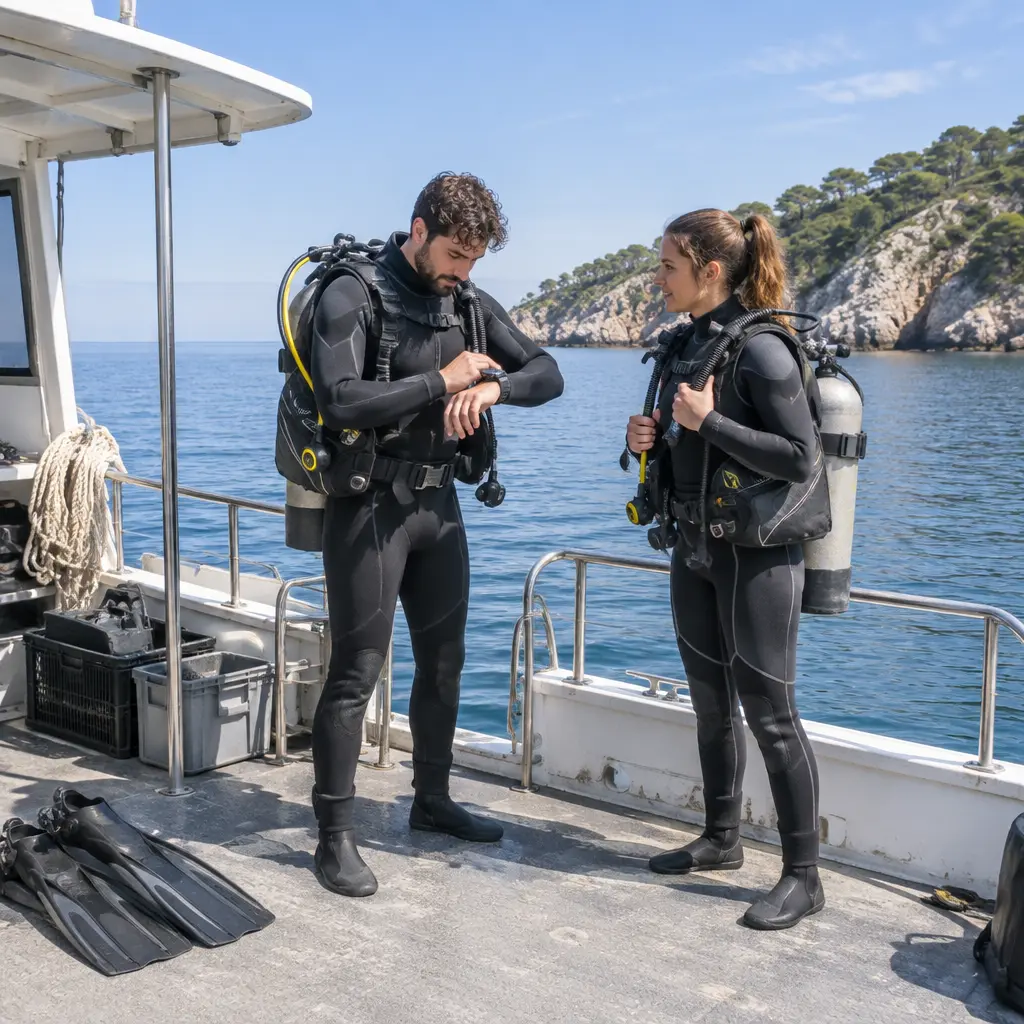
Equipment checks and communication turn individual skills into coordinated buddy diving. Before entering the water, divers confirm that essential gear is present, fitted, and functioning; underwater, they use agreed hand signals and maintain awareness of their buddy. PADI’s entry-level training materials include equipment use, buddy procedures, and underwater communication among core learning areas. These habits are especially important because spoken conversation is not practical underwater and a diver cannot assume a buddy has noticed a developing problem.
Check the gear before entering the water
A pre-dive check is a deliberate inspection of the diver’s and buddy’s equipment before the dive. Students learn to verify key items such as the cylinder and valve, regulator function, BCD inflation and deflation, weights, exposure protection, mask, fins, and alternate air source. Many divers use a buddy-check sequence to make the inspection systematic. A check does not replace proper equipment servicing or instructor supervision, but it can reveal a loose connection, missing item, or unfamiliar setup before the dive begins.
Recognize hand signals and stay with a buddy
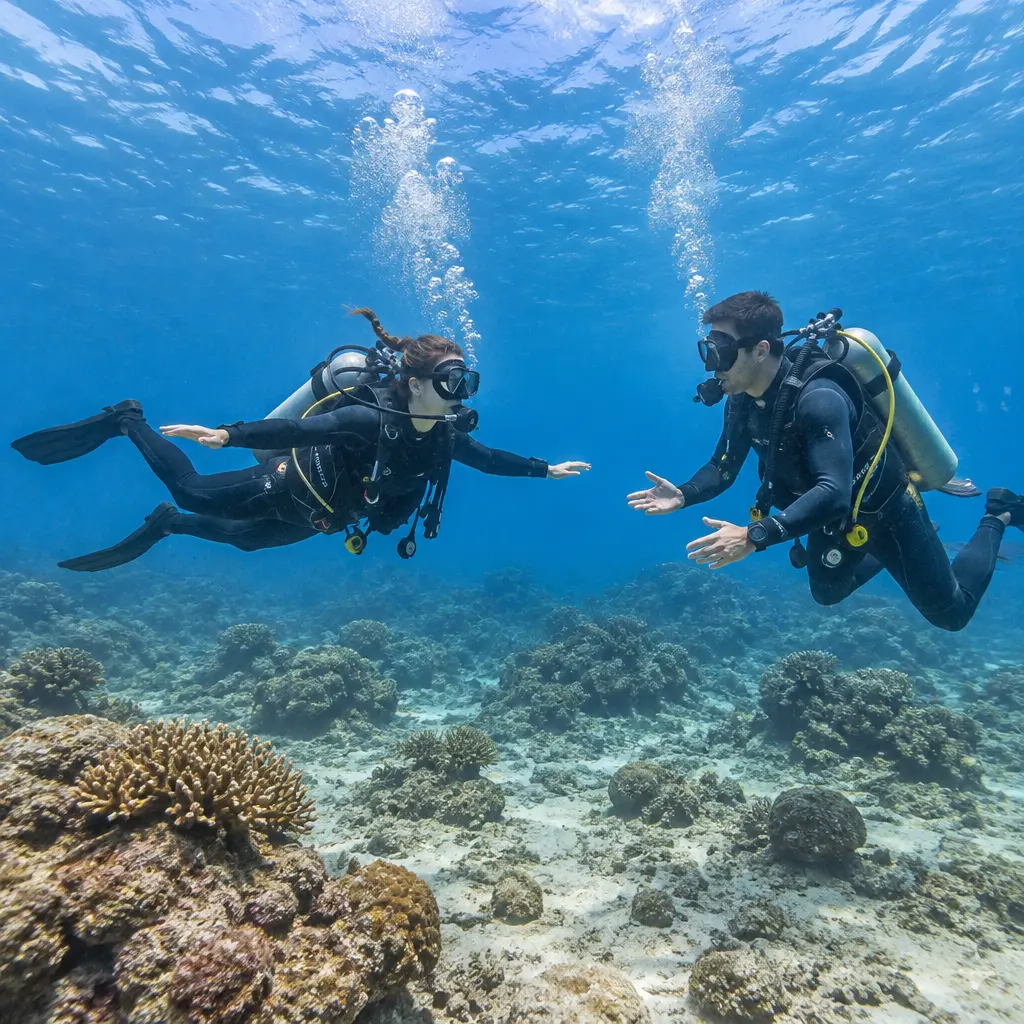
Underwater hand signals are agreed visual cues for messages such as “OK,” “problem,” “up,” “down,” and “low on air.” Students practise both giving and responding to signals, then learn to keep their buddy within a manageable distance and in view. If a diver becomes separated, the response should follow the training agency’s procedure and the conditions of the dive plan—not an improvised search that creates further risk. Before entering the water, buddies should agree on signals, the route, maximum depth, and what to do if separated.
Practise safe ascents and basic problem response
An ascent is a planned return toward the surface, not simply swimming upward when the dive is over. New divers practise controlling their rate of ascent, monitoring their surroundings, and following the dive plan, including any required safety stop. They also rehearse responses to common problems, such as a displaced mask or a regulator that is out of the mouth. These exercises are conducted under instructor supervision; they are not a substitute for training tailored to the diver’s certification level and local conditions.
Control the ascent and follow the dive plan
A controlled ascent gives the diver time to manage expanding gas in the BCD and maintain awareness of the buddy and surroundings. Students learn to ascend at a controlled pace, avoid holding their breath, and make a safety stop when required by their training, dive plan, or conditions. A safety stop is a precautionary pause near the end of a dive; it does not make an otherwise unsafe dive safe. Divers should follow the limits and procedures taught by their certifying agency and use a dive computer or other appropriate planning method as trained.
Recover a regulator and clear a mask
Regulator recovery and mask clearing are basic water skills that help a diver regain comfort and continue breathing if equipment shifts or water enters the mask. Instructors teach students how to recover the regulator, re-establish a normal breathing pattern, and clear a partially or fully flooded mask while maintaining control in the water. These exercises can feel unfamiliar at first, so they are practised progressively in confined water before open-water application. A student who is uncomfortable should tell the instructor rather than rush through a skill.
Learn the skills in a supervised progression
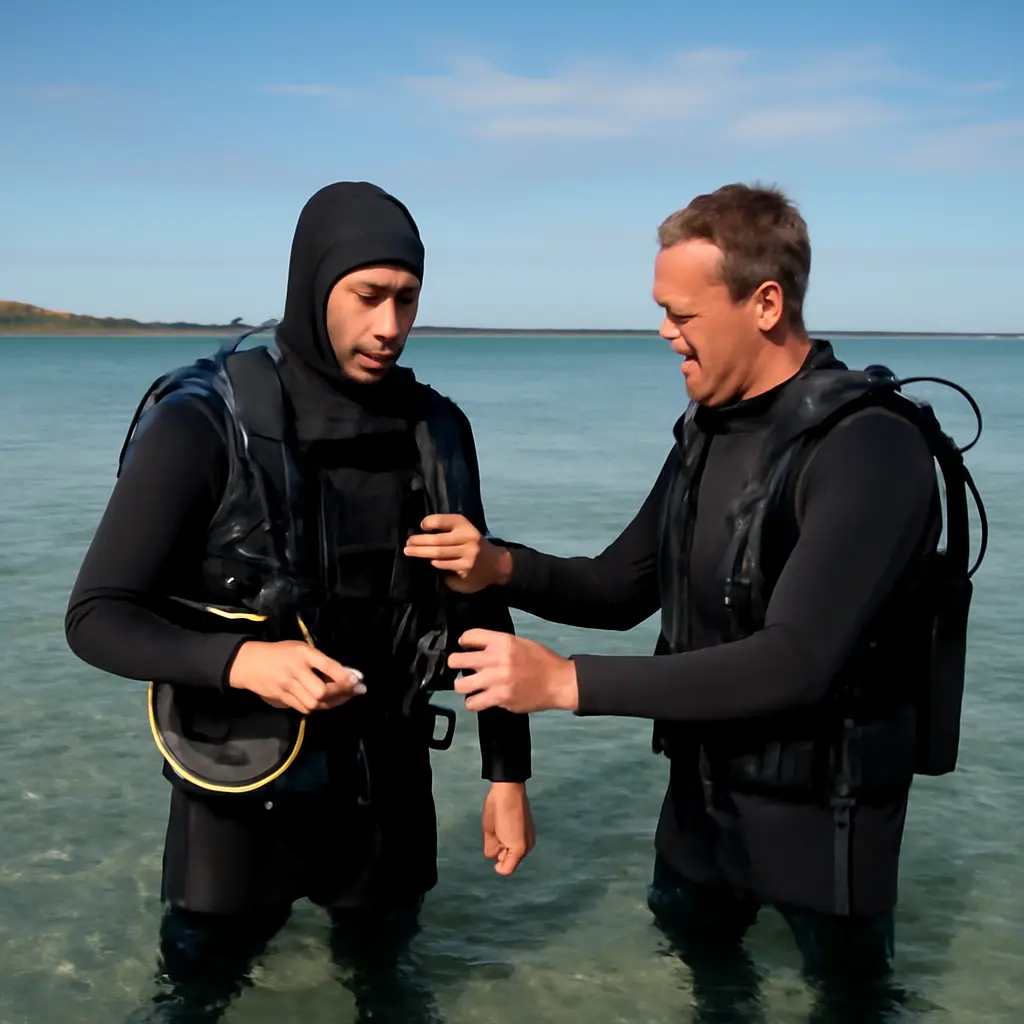
Entry-level scuba training generally progresses from knowledge development to confined-water practice and then supervised open-water dives. The precise schedule and performance requirements depend on the certifying agency and course. For example, PADI’s Open Water Diver course includes knowledge development, confined-water training, and four open-water training dives; other agencies structure their courses according to their own standards. This staged approach lets students practise fundamental skills in a controlled setting before applying them in natural conditions.
A practical example is a student who initially struggles to hover without touching the bottom. In confined water, an instructor can help adjust weighting, refine breathing, and practise small BCD changes. The student can then apply the same adjustments during an open-water dive while staying close to a buddy and following a planned route. That progression connects buoyancy, communication, gas monitoring, and environmental awareness rather than treating each skill as an isolated trick.
The broader safety context reinforces why training matters. DAN’s annual diving incident reports document fatalities and injuries, but incident counts should not be mistaken for a per-dive risk rate: the number of dives taken is not always known, and reports are subject to limitations in data collection. The useful lesson is not that one statistic predicts an individual outcome; it is that careful training, appropriate supervision, conservative planning, and honest self-assessment are important parts of risk management.
Conclusion: Put the first scuba skills together
The first skills every new scuba diver learns—buoyancy control, continuous regulator breathing, pressure equalization, equipment checks, buddy communication, controlled ascents, and basic equipment recovery—work as a connected system. Buoyancy and breathing help a diver remain in control; equalization and a measured descent protect comfort; buddy procedures and equipment checks support preparation; and ascent practice helps close the dive safely. Learn these skills through a recognized course, practise them with a qualified instructor, and continue refreshing them as conditions or equipment change. For further reading, consult your certifying agency’s training materials and Divers Alert Network’s dive-safety resources.
Sources: Professional Association of Diving Instructors (PADI), Open Water Diver Course, https://www.padi.com/courses/open-water-diver; World Recreational Scuba Training Council (WRSTC), Recreational Scuba Training Council Standards, https://wrstc.com/standards/; Divers Alert Network (DAN), Annual Diving Report, https://dan.org/research-reports/research-studies/annual-diving-report/; Divers Alert Network (DAN), Equalizing Ears, https://dan.org/health-medicine/health-resources/diseases-conditions/ears/equalizing-ears/; Divers Alert Network (DAN), Buoyancy Control, https://dan.org/alert-diver/article/buoyancy-control/.